The Victim, the Rescuer and the Persecutor: three roles behind so many of the conflicts we keep having, including the ones about money.

By Lisa Chastain | Creator of the Financial Emotional Intelligence Framework
Money & Mindset
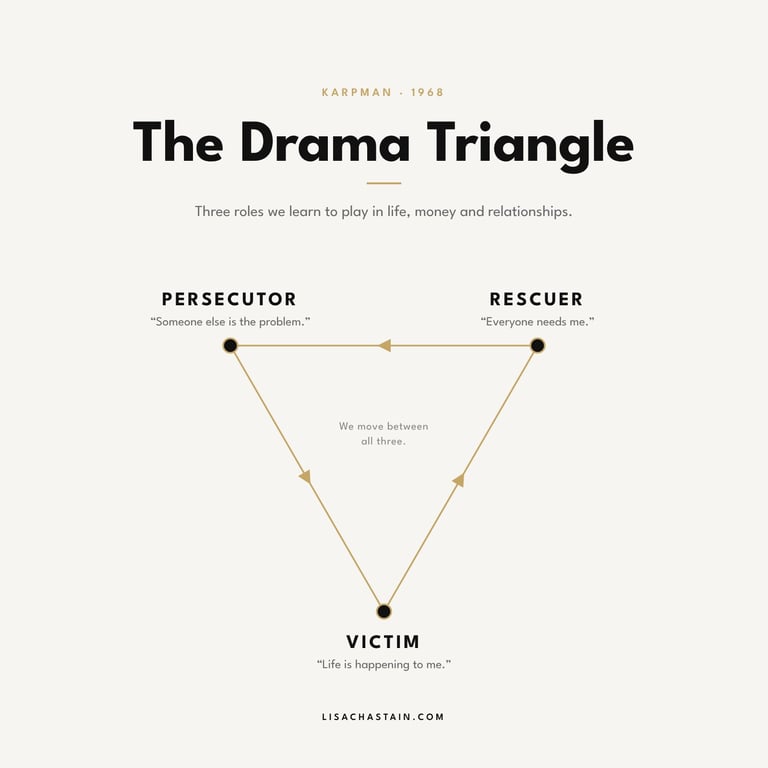
The Drama Triangle, in brief
The Karpman Drama Triangle is a model of human interaction introduced by psychiatrist Stephen Karpman in 1968. It describes three roles people move between in conflict: the Victim, the Rescuer and the Persecutor. These roles are learned positions, not fixed identities, and they often shape how we handle relationships, responsibility and money.
There comes a point in our personal development when we have to stop focusing exclusively on what is happening around us and become curious about what is happening within us.
I've spent years coaching successful, intelligent, accomplished people who find themselves navigating the same challenges over and over again. The circumstances change. The relationships change. The amount of money they make changes. Yet the underlying experience remains remarkably familiar.
One of the most valuable frameworks for understanding why this happens is the Drama Triangle.
The Drama Triangle is a framework for recognizing the roles we take on when a relationship or situation becomes reactive. Karpman identified three roles that people move between in dysfunctional interpersonal dynamics: the Victim, the Rescuer and the Persecutor.
What makes this framework useful is that these roles are not necessarily who we are. They are positions we learn to occupy, sometimes without realizing it, in response to our circumstances and relationships.
In 1968, psychiatrist Dr. Stephen Karpman introduced the Drama Triangle in his paper, Fairy Tales and Script Drama Analysis, published in the Transactional Analysis Bulletin. His work emerged from Transactional Analysis, a psychological framework developed by psychiatrist Dr. Eric Berne that explores human interactions, communication and the unconscious scripts we develop throughout our lives. Karpman studied under Berne, and the paper went on to receive the Eric Berne Memorial Scientific Award in 1972.
“Life is happening to me”
The Victim operates from a perceived lack of power, choice or control. Their attention is often focused on what other people have done, what circumstances have prevented them from accomplishing or what needs to change before they can move forward.
This might sound like:
There is an important distinction between experiencing genuine harm or injustice and occupying the Victim role in this framework. Taking personal responsibility does not mean accepting blame for what someone else has done. It means recognizing where we still have the capacity to make choices.
“Everyone needs me”
The Rescuer finds purpose, significance or security in taking responsibility for others. They are often generous, capable and genuinely caring people who have learned to associate their value with how much they do for everyone else.
This might sound like:
There is a meaningful difference between supporting someone and assuming responsibility for their life. When we continually rescue people, we may unintentionally interfere with their opportunity to develop their own capabilities.
“Someone else is the problem”
The Persecutor attempts to establish control through criticism, blame, judgment or demands. Beneath these responses may be fear, frustration, resentment or a desire for security.
This might sound like:
We can also direct these responses inward. The relentless inner critic who tells us we should be further ahead, earning more, doing better or making fewer mistakes can reflect this same dynamic.
Yes. One of the most important aspects of Karpman's work is that we can move between all three roles, sometimes within a single conversation.
Consider someone who has spent years financially supporting a family member. They initially offer help because they care. Over time, they become exhausted and resentful. They begin criticizing the person they have been helping and eventually feel unappreciated and taken advantage of.
The same person, over time
The circumstances may be legitimate, and the emotions may be entirely understandable. What is worth examining is the pattern itself, particularly when it continues to produce outcomes that neither person wants.
Money is one of the clearest places to see these roles at work, because financial decisions carry our beliefs about safety, love and responsibility.
The Victim with money believes their financial situation is the result of forces outside their control, so the next step always waits on someone or something else changing.
The Rescuer with money financially supports adult children beyond what is sustainable, repeatedly bails out family members or sacrifices personal financial security to meet the needs of others.
The Persecutor with money blames a spouse, a parent or themselves for every financial setback, and tries to create security through control and criticism.
I see all three in my financial coaching work. This is why I believe money is emotional before it's mathematical. Our financial decisions are often influenced by a much larger relationship with ourselves, our families and the world around us.
Many of our earliest lessons about love, money, responsibility, safety and belonging come from observing the people who raised us.
Some of us learned that being needed was how we earned love. Others learned that maintaining control was how we stayed safe. Some learned that expressing our needs created conflict, while others learned that someone would eventually come along and solve our problems.
Through modeling, childhood experiences and repeated reinforcement, these responses can become familiar ways of navigating life.
We carry them into our marriages, our parenting, our businesses, our leadership and our financial decisions. We may even build successful careers around the very patterns that leave us feeling exhausted in our personal lives.
In 2005, author David Emerald introduced an alternative framework in his book, The Power of TED* (*The Empowerment Dynamic). It offers three constructive alternatives to the original Drama Triangle:
| Drama Triangle role | Empowerment Dynamic alternative | The shift |
|---|---|---|
| Victim | Creator | From “this is happening to me” to recognizing the choices still available |
| Rescuer | Coach | From fixing others to supporting them in developing their own capabilities |
| Persecutor | Challenger | From blame and control to clear expectations and boundaries |
The Creator recognizes their ability to make choices, even within difficult circumstances. The Coach supports others in developing their own capabilities. The Challenger communicates expectations, establishes boundaries and encourages growth without diminishing others.
Each of these shifts requires us to develop a greater awareness of our own responses and a willingness to practice something different.
Personal responsibility is not about taking responsibility for everything that has happened to us. It is about taking responsibility for how we choose to live moving forward.
You can read about the Drama Triangle, recognize yourself in all three roles and have a comprehensive intellectual understanding of why you do what you do.
Then you can go home, have a conversation with your spouse, receive a phone call from a family member or face a financial decision and find yourself responding exactly as you always have.
I've seen this throughout my years of coaching. People know an extraordinary amount about themselves, yet still struggle to translate that knowledge into a different lived experience.
This is the distinction between education and change.
Awareness is essential. Creating lasting change also involves examining the beliefs, emotions and learned responses underneath our behavior, developing new ways of relating to ourselves and others, and practicing those responses in our everyday lives.
The Wealth Within
This is why we created The Wealth Within, a four-day immersive experience in Las Vegas.
We bring together financial education, emotional intelligence, experiential exercises and personal development to explore the long-standing patterns that influence how we live, earn, spend, lead, love and relate to others.
This experience is for people who are ready to examine what is driving their decisions, redefine their relationship with responsibility and begin creating a life that reflects what matters most to them.
Our work extends well beyond money. It is about developing the internal capacity to experience greater peace, security and freedom in the lives we are building.
Next Experience
January 14–17, 2027 · MEET Las Vegas
Downtown Las Vegas, Nevada
If you are curious about this work and whether the experience is right for you, schedule a conversation with Casey on our team. It is an opportunity to ask questions, share where you are in your life and explore whether The Wealth Within is an appropriate next step for you.
In the meantime, one question
How much of the life you are living today is a result of conscious choice, and how much of it is a continuation of a role you learned to play years ago?
About the Author

Money Coach · Author · Certified NLP Trainer
Lisa Chastain is a personal finance expert, NLP trainer and the creator of Financial Emotional Intelligence. She is the author of Stop Budgeting, Start Living, a #1 Amazon New Release, and the #1 bestseller Girl, Get Your $hit Together, the host of the Real Money podcast and the co-founder of The Wealth Within.
A former registered investment adviser representative, Lisa coaches successful people to understand the emotional patterns behind their financial decisions.
This article is educational and is not a substitute for therapy or mental health care. If you are navigating serious relationship harm, please reach out to a licensed professional.
The original paper · 1968
Fairy Tales and Script Drama Analysis
Stephen B. Karpman, MD · Transactional Analysis Bulletin 7(26), 1968. The paper that introduced the Drama Triangle.
Book · 2014
A Game Free Life
Stephen B. Karpman, MD. A fuller exploration of the Drama Triangle and interpersonal relationships, by its creator.
Book · 2005
The Power of TED* (*The Empowerment Dynamic)
David Emerald. A practical approach to moving from reactive patterns toward empowered choices.
Book · 1964
Games People Play
Eric Berne, MD. Foundational reading on Transactional Analysis and interpersonal dynamics.
Weekly Letters
Notes on the patterns behind your financial decisions — plus what I am reading, recording, and learning. No hype, no funnels, no daily emails.
Unsubscribe any time. Your email stays with Lisa.